Saturday, November 12, 2011

Restaurant Atao - A bit of Brittany in Paris


We’re finally back in Paris after almost six months in the States and Italy and I am ready to dive back into the restaurant scene to share my discoveries with you!
Last night my husband Kent and I tried a neighborhood restaurant in Batignolles that changed hands over the summer. Formerly a simple but good seafood restaurant offering oysters, mussels, etc, Atao, which means eternity in Breton, was opened by Laurence Maheo, an oysterman from the Golfe du Morbihan off the south coast of Brittany. All of the fish and seafood come daily from Brittany and the oysters are cultivated by Laurence and his family.
The dining room is blue and white, like the sea and the sand in Brittany. All 20 seats were taken which is always a good sign. We did not try the oysters this time but started instead with a creamy oyster soup and a dish of girolles with an oyster emulsion. The oyster soup was very flavorful but had only 2 little oysters floating around

in it, a far cry from the delicious oyster stews we Americans are used to. The girolles with a splash of oyster flavor were however quite delicious..

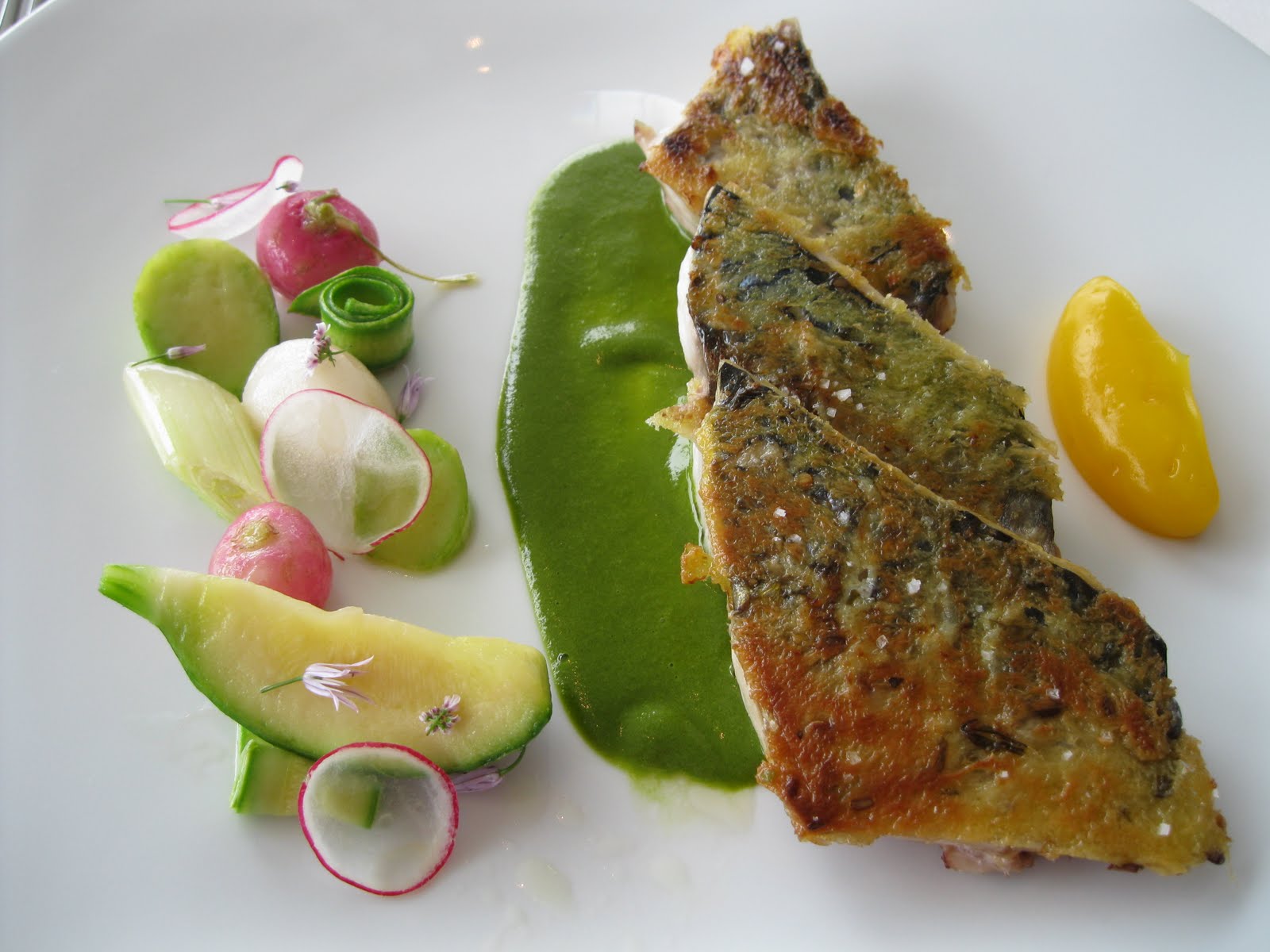
For our main courses we both had fish, which was fresh as could be and perfectly cooked. Kent selected Filets de Maquereau Laqué, 2 generous filets of mackeral lacquered with a soy sauce glaze and served on a bed of spinach with mashed potatoes and an array of root vegetables, grown by Michelin 3-star chef Alain Passard.


The white beets, yellow carrots, and turnips were crunchy and bursting with flavor, a nice contrast to the moist, succulent fish. My Filet of Daurade (sea bream) came with the same wonderful vegetables and an emulsion of basel.
We drank a bottle of Cheverny Blanc 2010, Villemade and were perfectly satisfied, so we skipped the house made crèpes offered for dessert.

We however made up for that today at lunch when we feasted on a Kouign Amann, a super rich Breton butter cake a friend brought from San Malo. One of my favorite chefs in Brittany, Patrick Jeffroy makes a superb Kouign Amann and I have his recipe which I am giving you below. If you can’t get to Brittany, this cake is well worth the effort.


Kouign Amann
(Breton Butter Cake)
Patrick Jeffroy (Restaurant Patrick Jeffroy)
(Serves 8)
Ingredients:
2 c. flour
1-1/4 c. sugar
2 7-g packets of dry active yeast
11 T. butter (keep one stick in refrigerator (8 T.) until called for.
1 t. salt
Preparation:
· In large bowl dissolve yeast in 1/3 cup lukewarm water.
· Set aside until yeast begins to activate and foam, in about 10 minutes
· Add salt and 1 cup flour.
· Stir with a wooden spoon
· Add 1/3 cup of water
· Blend well.
· Add remaining 1 cup of flour.
· Add another 2/3 cups of water.
· Stir until dough forms into a ball.
· Transfer to a lightly floured work surface.
· Knead with heels of your palms until smooth and elastic
· Coat the inside of a large bowl with butter.
· Place dough in bowl, cover with damp cloth or plastic wrap.
· Set aside to rise until doubled in bulk, about an hour.
· Preheat oven to 450 degrees F.
· Grease a 9-inch pie pan with butter.
· Dust it with flour.
· On a lightly floured work surface, roll out the dough to form a large 12x18 rectangle, with shortest side closest to you.
· Cut the chilled stick of butter into 12 pats.
· Place the pats around the center portion of the dough.
· Sprinkle with ¾ cup of sugar.
· Fold short sides toward center over butter and sugar, moving quickly
· Sprinkle dough with sugar.
· Roll over the seems to form a seam.
· Turn dough around so shorter side is closest to you.
· Fold into thirds, as if a letter going in an envelope.
· Place dough in refrigerator to rest 15 minutes.
· Sprinkle sugar over work surface.
· Roll out dough into a large rectangle, dusting as you go with ¼ cup of sugar.
· Folding in thirds again, place in fefrigerator to rest.
· Sugar work station lightly again.
· Roll out dough into a square, slightly larger than the pie pan, dusting as you go with remaining ¼ cup of sugar.
· Press dough gently into pie pan.
· Melt and drizzle remaining 3 tablespoons butter over dough.
· Sprinkle with sugar, baking 35-40 minutes until golden.
· While still hot, remove from pan and serve warm.

Wednesday, May 25, 2011

Lunch at the Mirazur in Menton


We arrived a few days ago at our little Italian hideaway in the perched village of Fanghetto built more than 1000 years ago. After two days of traveling from Paris, it is always a relief (given autoroute driving) and a thrill to arrive. The  weather has been perfect, sunny with cool dry breezes and wildflowers are everywhere. There are still snow-capped mountains in the distance making this paradise even more perfect.
View from our Terrace
We are just fifteen minutes from the sea in Ventimiglia which has an unbelievable covered food market with remarkably reasonable prices. We stocked up on all the spring delicacies - artichokes, new peas, fava beans, many different salad greens and the first strawberries and tomatoes from Sicily. We put our feet up and enjoyed meals on our terrace for the first couple of days.

Then yesterday, we and two friends, drove thirty minutes into France and treated ourselves to lunch at Mirazur, a restaurant with one star in the Michelin Guide, which is on a hillside just outside of Menton with panoramic views of the city which is known as “ The Pearl of the Cote d’Azur”.

Menton
I have known the chef, Mauro Colagreco, since he first opened Mirazur in 2006. He is originally from Argentina but spent more than 10 years working in two Michelin three star restaurants, Le Cote d’Or with Bernard Loiseau in Saulieu and L’Arpege with Alain Passard in Paris. Mauro grows many of his own vegetables, including little known varieties from Argentina, in a garden on top of the hillside. His food is fresh and stunningly beautiful.

Lunch is a bargain if you stay with the menu du dejeuner, available weekdays only. For 33 euros, you will have a feast. We ordered a provencal rose, Rimaureq 2010 cru classe which we had as an aperitif and continued drinking throughout lunch as it was crisp, with just the right amount of fruit and it complemented everything we ate nicely. Mauro serves tapas and then an amuse bouche to double your pleasure. The tapas were black rice chips with a vegetable tartar and polenta chips with a goat cheese cream, studded with cucumbers. The amuse bouche which followed was a delicate dollop of cream of cabbage soup with a mustard cream quenelle and a sliver of radish to add a little punch. 

For our first course we were served a carpaccio of gascon, a local white fish with a citrus vinaigrette and tiny edible flowers. We had a choice of fish or fowl for our main course. Three of us enjoyed the mackeral with a quenelle of manderine orange cream sprinkeled with Angelique flowers.


My husband Kent devoured every bite of his farm raised chicken, served with white asparagus, a cream of green asparagus, radishes and bits of caramelized juice from the chicken as it cooked.

So far every bite was as heavenly as the setting. Dessert however was a disappointment. It was an assortment of pastel colored sorbets and creams, including a saffron cream and an orange sorbet with orange flower bread. The colors on the plate matched the colors of the Menton buildings in the distance which was lovely to look at but the dish lacked flavor sadly.

At the end of the meal, we were served a complimentary glass of homemade limoncello and then we left for a nap on the nearby beach to dream of a meal which, despite the dessert, was a true feast for all our senses.

As many of you know, my business, Les Liaisons Delicieuses, (www.cookfrance.com) has been running culinary vacations for 17 years all over France, Italy, Morocco and Vietnam. I have an exciting new trip to both the French and Italian Rivieras, September 25- October 1, 2011. Mirazur and Mauro are highlights of this trip which still has a few spaces available. Email me at patricia.ravenscroft@gmail.com for details.

Recipe Fricasse d'Artichauts facon Barigoule
Serves 8

12 artichokes
4 cups sliced mushrooms
1/2 pound lean salt pork
1/2 pound sliced raw ham
Chopped tomatoes
Garlic
Onion
Parsley
Olive oil
Lemons

The lactarius mushroom “barigoule” in provencal, was simply sprinkled with olive oil and fried on charcoal.

Even though the recipe has changed, the name barigoule has remained.

Prepare the artichokes by cutting off the bottom tail and taking off the small leaves and the top of the upper leaves. Boil for 5-8 minutes. Drain and reserve.

Stuffing preparation:

Wash and thinly slice the mushrooms. Cut the lean salt pork into small pieces. Chop the raw ham. Mix with garlic, onion and parsley. Stuff the artichokes with the mushroom and ham mixture. In a deep saucepan, sauté the onion and chopped tomatoes in olive oil. When the mixture is cooked through, add the stuffed artichokes. Put in the oven uncovered for 10-15 minutes and sprinkle from time to time with dry white wine. Bring to a boil, cover and lower the temperature to cook slowly for 45-60 minutes.

Monday, May 16, 2011

Sola - another little gem in Paris

In our last week before leaving Paris for 5 months, we discovered a sensational restaurant in the 5th with a very talented young Japanese chef – Hiroki Yoshitake. Just remembering this meal makes my mouth water.

Sola is hidden on a little street in the  5th  (12, rue de l'Hotel Colbert) and has a very ordinary exterior. When you walk in however, nothing from that moment on is ordinary. You feel like you have entered a wine cave which has been lovingly cared for and the young Japanese staff greet you warmly and respectfully. The tables and tableware are simple yet quite beautiful and complement the stonework nicely.

There are two menu choices at lunch, 35 and 50 euros, and at dinner, 45 and 60 euros. With the less expensive menu you choose between fish or meat for the main course. At the higher level, you get both but everything else is the same. Four of us chose the 35 euros lunch menu which was truly splendid. We ordered a 2009 Saint-Aubin dom Pierre Yves Colin-Morey which was a rich sophisticated white that was so good we did not switch to a red later on in the meal.

Our lunch began with a veloute de fenouil, a creamy fennel soup with hints of grapefruit and a few drops of olive oil infused with lemon. We continued with a tartare of salmon with burrata cheese, drizzled with a beet cream and sprinkled with feuilles de shiso, tiny tasty Japanese greens which were a theme throughout our lunch.


The third dish was one of the best things I have ever eaten and like every dish, beautifully presented. It was described as an omelette with foie gras but was so much more! A generous piece of foie gras had been seared in a pan with a little honey. It was served on top of several spears of white asparagus and topped with a poached egg with shavings of parmesan and pousse de miel, another delicious baby green. I savoured every bite and could have had seconds!


Two of us continued with fish, which was merlan, served with delicious potatoes from Noirmoutier, and radishes, on a bed of garlic with an emulsion of mussels and other shellfish. The fish was perfectly cooked and all of the flavors worked very well together.


The beef was rare and tender and was served with radish, mushrooms and a sorrel/wasabi sauce also delicious and original.

Dessert was a lovely mélange of meringue, a dark chocolate cream, and homemade vanilla ice cream, a perfect end to a heavenly meal.


I am sending all of my friends to Sola as I truly loved their food. When we return to Paris in October, I will be back there in a flash and hope to organize some cooking classes with the chef who is interested.

The recipe for this week is something very simple which I cooked last night for a couple of close friends.

Magret de Canard with a Port Wine sauce
For 4-6 people

2 large magret de canard, trimmed
1/2 liter of veal stock ( you can use powdered but only Maggi fond de veau)
1 to 2 cups of port
 
To make the sauce, simmer the veal stock and the port until reduced to a thick delicious sauce - 30 minutes approximately.

Then in a very hot saucepan, cook the duck breasts, skin side down, for 5 minutes over high heat. Reduce the heat, drain some of the fat, and turn the duck over and cook for another 3-5 minutes for rare. Serve with the sauce. Enjoy!

Next week I will be blogging from our little village of Fanghetto in Italy but only 45 minutes from Nice.


Monday, May 2, 2011

La Rive Droite - A Star in Alencon

Just a few weeks ago I was in sunny Marrakech, which Kent and I discovered for the first time when we attended Charles-Henry and Segolene’s wedding there in February of 1998. And, just last Sunday for Easter, we had the pleasure of having lunch at their new restaurant, La Rive Droite, in Alencon. The connection  between Marrakech and La Rive Droite was striking - the brilliant blue skies, delicious food, and the décor as well, as their bar is decorated with many treasures and colors from Morocco.
Charles-Henry, Segolene and their three young sons are like family and it is always a pleasure to participate in their enterprises and adventures. Their Chateau Hotel, the Chateau de Saint Paterne has been the scene of many wonderful Les Liaisons Delicieuse’s culinary adventures. I have slept in every one of their exquisite guest rooms, including one with a remarkable painted ceiling where King Henry IV spent time with one of his mistresses! Because of Charles-Henry, I began running culinary tours with him beginning in Morocco in 2001 and in Vietnam in 2006.

But on to their newest enterprise, La Rive Droite. They bought the old lace museum on the Sarthe river in the old part of town several years ago.

La Rive Droite situated on the Sarthe River
It had been abandoned and needed a complete rehabilitation which they did with their usual flair. There are four different dining areas on the main floor each decorated differently and very beautifully. My favorites are the library which is very cozy in the wintertime filled with books and treasured photographs, and the Moroccan room.

La Rive Droite's moroccan room
In the spring sunshine however, the terrace is where you want to be. Four of us enjoyed our Easter lunch on a day as warm and sunny as Marrakech which was really delightful.

For years at the Chateau de Saint Paterne, Charles-Henry was the cook for the dinners served to guests in their dining room. But, with the opening of La Rive Droite right before Christmas, he hired a chef and graduated to manager of both kitchens he told me gleefully!

All four of us began our lunch with a Tourte de carottes en robe de chou which is one of Charles-Henry’s signature dishes, although this time prepared by chef Laurent. The carrots which are still crunchy are wrapped in savoy cabbage leaves and dressed with a sauce of crème fraiche and chives.

Tourte de carottes en robe de chou
The textures and flavors worked amazingly well together. We enjoyed a very pleasant Domaine Deshenry Cotes de Thongue 2010 white wine with our starters.

Two of us continued with the souris d’agneau which had been cooked with a little raspberry vinegar. The lamb fell easily off the bone and was incredibly succulent. The touch of raspberry was perfect. The second main course we ordered was magret de canard au miel. The duck was pink, tender and very tasty, complimented by a sweet and sour sauce of honey and balsamic vinegar. Both dishes were served with a medley of spring vegetables.

Souris d'agneau
Our wine for this course was a Domaine Cavalier du Val de Montferrand 2011 which was full bodied with a slight taste of berries.

We shared two desserts, a rich delicious Tarte Tatin and handmade ice cream with a touch of calvados, and a fondant au chocolat which was properly warm and runny with hints of caramel and butter.

Tarte tartin
Both desserts were wonderful. We left for a walk along the river completely satisfied. You should really consider a weekend at St. Paterne with a lunch at La Rive Droite but it is possible to take the train for the day and have a marvelous lunch and be back in Paris for dinner.

This week's recipe is for our starter:

Tourte de Carottes en Robe de Chou (Carrot Tart Baked in Cabbage Leaves)
Recipe from Charles-Henri de Valbray, Château-Hotel Saint-Paterne
Serves 8

Ingredients for the Tart
8 large leaves of Savoy cabbage
6 large carrots
¼ head cabbage
1 turnip, if desired
3 onions,
2 cloves garlic
1 bunch parsley
4 leeks, white only
1 ½ sticks of butter
5 eggs
Pinch of cayenne pepper
Salt and pepper
Toasted pine nuts
 
Ingredients for the Sauce
1 cup cream
3 tsp minced chives
Salt and pepper
2 tbsp butter

Wash the cabbage leaves and blanch for 3 minutes in boiling salted water. 
Plunge in cold water, remove and dry between paper towels or tea towels.
Remove large ribs.
Wash cabbage, leeks and peel turnip and carrots.  Grate cabbage, turnip, and carrots; slice leeks finely.  Chop onion, garlic and parsley.
Melt 7 tbsp butter in a large saucepan, add grated cabbage, leeks, and onions and sauté gently 5 minutes.  Add carrots, garlic and parsley.
Cook vegetables together for 15 minutes over low heat, stirring from time to time.  Add the cayenne, salt and pepper.  Remove from heat and let cool.  Beat eggs and fold into vegetable mixture, mixing well.
Butter a deep straight-sided pie or cake pan or earthenware casserole with half the remaining butter.  Line the pan with the cabbage leaves, keeping one leaf aside.  Let the leaves extend over the edges of the pan.
Pour the vegetable and egg mixture into the pan.  Fold the leaves over the mixture and top with the remaining leaf.  Dot with remaining butter.  Cover with aluminum foil and bake for 30-40 minutes at 350F.
While tart is baking, prepare the sauce.  Melt butter in cream over low heat.  Add chives, salt and pepper, mix well, and pour in a sauce boat.
Unmold tart on a large round serving place, sprinkle with pine nuts, and serve with sauce.

Monday, April 25, 2011

Marrakech and Essaouira

I have been to Marrakech and Essaouira six times now, beginning 13 years ago, when my husband Kent and I attended an amazing French wedding in 1998. Taking place in Marrakech, the wedding included a week of additional parties and excursions, including 2 days in Essaouira.  We smuggled in Grants whiskey, illegal then, for the opening cocktail atop a splendid Riad, strewn with rose petals and glimmering with candles, with the Katubia Mosque silhouetted in moonlight.  After the wedding we rode with nobility in horse drawn carriages deep into the Medina, torch bearers lighting our way as Berber bands serenaded us en route to a grand reception gala.  Memories were whetting my appetite for our arrival in Marrakech.

Getting off the train this time, I was amazed by the changes in the city. In the 5 years since I was last here, the roads have been greatly improved, the monuments cleaned, gardens manicured and even the souks were less dusty and chaotic. There is definitely a sense that life is better with King Mohammed VI, who has done a great deal for the country and for all his valued tourists.

Except for our last day, we had those brilliant blue Moroccan skies I dream about bringing balmy days and cool breezes at night. In Marrakech we stayed at Jnane Tamsna, an oasis in the Palmerie, 20 minutes outside the city.

Photo of Jnane Tamsna doorway
The owners, Meryanne Loum-Martin and her husband Gary have been friends for 10 years. I have known Bahija, their young female chef since she was barely out of her teens beginning her life as a cook. She and her husband and young children still live with her mother, the inspiration for her tagines and couscous.  She has turned into a remarkably accomplished chef who has taught herself English and is a fabulous teacher.

We had two cooking classes with Bahija in Meryanne’s sumptuous private residence and kitchen.

Cooking with Bahija
The first was on poultry tagines, which could be either chicken, quail or squab.

Chicken tajine with fennel, fava beans and tomato
Since there were 14 of us, we found 14 individual ceramic tagines in front of us.  Using the same base preparation (recipe below), we then created our own unique tagines; 7 savory and 7 sweet. We shared (and devoured) our tagines at lunch in the palmerie garden, preceded by several salads with greens and herbs from their gardens. .In fact all the delicious vegetables that we ate were grown at Jnane Tamsna.

Our second cooking class with Bahija was on couscous, made of course the traditional way. Bahija had us prepare 4 different kinds of semolina made from corn, barley, and two different wheats, one commercially ground and one ground by hand by her mother. It was THE BEST! We made a 7 vegetable couscous to go with all of the semolinas, reproducing the dish Moroccan Muslims eat every Friday on their Sabbath. Bahija also taught us how to differentiate real from fake saffron made with red food dye.  When you drop fake saffron in water it turns red rather than the beautiful yellow of the real thing. We capped off our class by learning how to make and serve mint tea properly.

Well satisfied, we went out to see all the important monuments in Marrakech, going into the souks, but here food, cooking, and gardens, including the exquisite Marjorelle gardens where Yves St Laurent’s ashes now rest, were the highlights of this part of our trip.

Group visiting Marjorelle Gardens

We traveled by van to Essaouira and stopped en route to visit an argon oil cooperative.

Grinding argan nuts

We arrived at lunchtime and enjoyed a seafood lunch at a restaurant on the beach and then the gang hit the shops in the souks this time on their own as it is easy to get around in Essaouira.

View of Eassaouira

The next day we attended another wonderful cooking class with  Nour-eedine who is an amazing teacher. We cooked a zucchini with chermoula and the best fish tagine I have ever tasted!

It rained our last afternoon and evening in Essaouira and our return to Marrakech was dramatic indeed. I had never seen a drop of rain in Morocco and there was red water rushing everywhere except luckily not on the main roads. So, we had to abandon our last night in the desert and settled instead into the beautiful Palais Calipau in the Marrakech medina for our last night and last coucous, this time Royal with lamb and chicken as well as vegetables.  We got on our airplanes the next day loaded with carpets, leather goods, jewelry, spices and many wonderful memories.

Basic Tajine of Chicken with Lemons and Olives - Serves 8-10 people
To this basic recipe, you can add other vegetables such as potatoes, turnips, carrots, fennel, fava beans, peas. 
3 whole chickens, cut up – reserve thighs, legs and breasts
10 tbsp olive oil
2 cups chicken stock, plus extra
2 garlic cloves, grated
8 tomatoes, seeded, peeled and sliced vertically
1 red onion, chopped finely
2 whole confited lemons, quartered or halved and cut into fan shape
1 tsp salt per tagine
½ tsp saffron for each tagine
½ tsp pepper per tagine
1 tsp ginger per tagine
Pinch of cumin and turmeric per tagine
Handful olives per tagine
2 tbsp chopped cilantro per tagine

Brine chicken pieces in lemon juice and salt overnight.  Place 5 tbsp olive oil in each tajine and cook chicken pieces skin side down, first over medium heat, turning often to keep from burning.  Add 1 cup chicken stock to each tajine to cover.  Cook covered for 20 minutes leaving room for air to escape.  Add 3 heaping tbsp of chopped red onion to each tajine.  Grate one garlic clove into each tajine.  Add more chicken stock as needed.  Placed confited lemon pieces or fans on top.  Add tomatoes, spices (except the cilantro) and olives into each tagine.  Cover and cook for 20-25 further minutes (45 minutes total). 
Just before serving, sprinkle with cilantro and add additional pepper.

Sunday, April 3, 2011

Adventures on The Marrakech Express

To the lyrics of Crosby, Stills and Nash “The Marrakech Express” our porters packed up our Fez acquisitions and we were off to the train station, roller bags in tow. 

The trek down the side of the tracks then ACROSS the tracks with all of our luggage and into the first class train must have been quite a sight! Settling into three compartments, we piled our luggage wherever it would fit (we were a group of 14 but our luggage looked like it was for a group of at least 25!) 

Patti overseeing the luggage

Eventually our train set off, providing us with a variety of scenes along the way including green fields, storks, flocks of sheep and their shepherds, fields of mustard, some vineyards, cypress trees, military posts, and the ever present camels. 

Meknes, Rabat and Casablanca were just a few of the many stops, posing repeated challenges to me as people tried to invade our compartments since I had only booked 14 of the 18 seats.  It was a mad dance to see us moving into and out of compartments with our copious luggage scattered everywhere, including the aisles.

We were all ravenous by noon, so it was time to unpack our picnic lunch lovingly prepared by Fatima back at the Riad.  Alcohol is supposedly not allowed on the Marrakech Express (which is actually a milk train) but that didn’t stop us. I had warned everybody to hide the bottles of wine I distributed, but popping corks gave us away!  In our picnic, we discovered salads of eggplant, carrots and cumin, green peppers, rice and tuna fish, tomato and cucumber, and delicious French cheeses. Hard boiled eggs posed some peeling problems, and our shells were soon ditched in the bathroom for lack of wastebaskets.  The conductor discovered our dalliance but fortunately for us, he just smiled. At least half of our tasty lunch was left so we gave him our leftover bounty at the end of the trip, which he accepted with pleasure.
Our picnic (in red check bag) safely stowed with luggage!
After 7 hours of much hilarity, Marrakech finally came into view around 4pm.  We performed another hysterical transfer of people and baggage across a street with no crosswalk into 2 vans, once again with much muttering in Moroccan as they wedged things in.  I had worried it would be a long train trip, but everyone found it to be a fascinating adventure. 
Finally, we arrive in Marrakech

Friday, April 1, 2011

A Sublime Sojourn in Morocco

We made it!  In spite of political turmoil in many very-nearby countries, Kent and I and my twelve clients, now friends, arrived safely in Fez, the former imperial capital, last Friday to begin our ten day adventure in Morocco.  Nestled in the medina, our home for the first three days was the Riad Alkantara, lovingly restored by its owner Fettah Seffar who warmly welcomed us with mint tea and almond cookies on the terrace overlooking the pool and lush garden-- the largest in the entire medina.  Our guide in Fez was Mohammed Bouftila, affectionately called Momo, a  boyhood friend of Fettah’s.  Living near each other in the medina, they became friends at their neighborhood bakery where they brought their mothers’ dough each morning to be baked in the communal oven.  The Fez medina is divided into 270 such ‘neighborhoods’, each with its own communal bakery, mosque, school, hammam, and spring-fed fountain.  Fresh ripe vegetables, nuts, oils, cheeses, and lamb poured into their markets from the surrounding fertile Sias valley, awakening their palates at a young age, allowing them to tantalize us throughout our trip.

Both Fettah and Momo brought Fez to life for us by introducing us to many amazing artisans who are still creating the same beautiful leather goods, jewelry, ceramics and rugs as their ancestors hundreds of years earlier.  Fettah, himself an Oxford Ph.D., is an 8th generation plaster carver.  We visited his workshop deep in one of his palaces (riads) undergoing restoration where he showed us his intricate plaster carving techniques.  Momo took us to visit a weaver who makes fabric for the Royal Family in the traditional way, and to the oldest (9th century) and largest tannery in North Africa where several people bought gorgeous goat leather jackets.  It is the softest and yet most durable leather.

Bright colors at the tannery

We enjoyed several succulent tagines, including a beef tagine with quince, and a lamb tagine with spring peas and artichokes which Fatima, the cook, taught us to make in our Riad Alkantara cooking class and a superb Berber vegetable couscous.

A visual feast

After the class, Fettah had invited a henna artist to tattoo us in places and designs of our choosing, some selecting floral arm or hand patterns, others the striking Riad logo.
Traditional henna being applied
Sparkles adorned us as the henna dried.  Our gala dinner followed, lit by a thousand candles, as we dined on our own creations, accompanied by surprisingly good Moroccan reds and whites, a welcome new accomplishment by local vintners.  Tomorrow we set off for Marrakech.